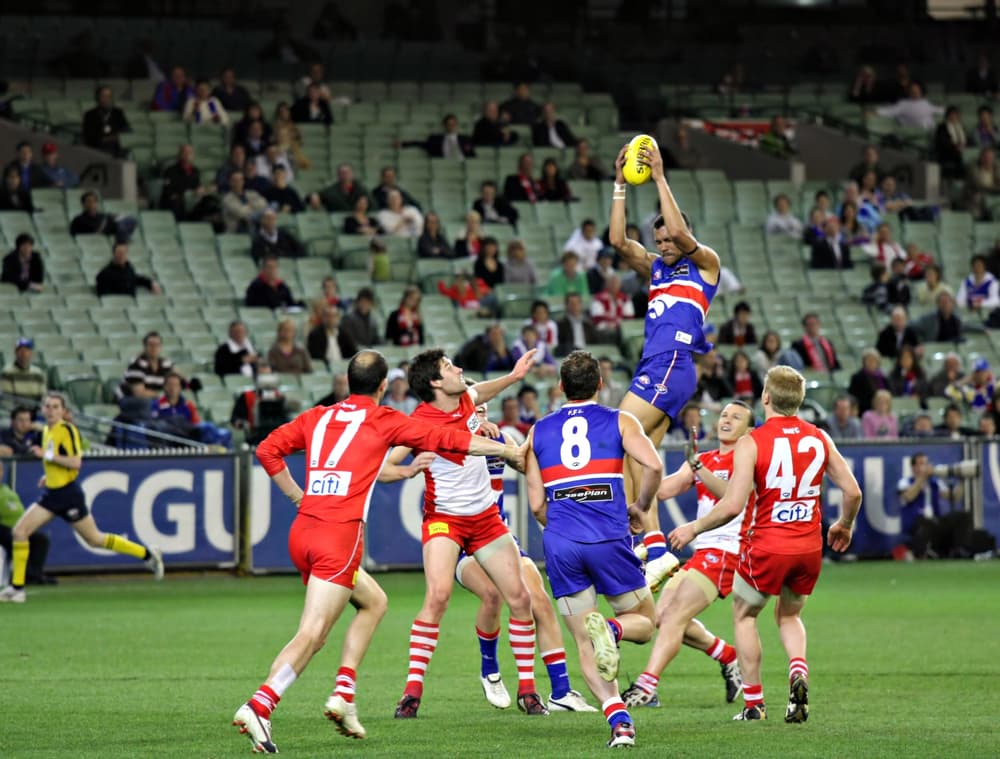
Concussion has become the most highlighted injury in Australian-rules football in recent years.
It was once dismissed as “getting your bell rung” or a minor injury. However, rising awareness of long-term consequences, including neurological, cognitive, and mental health issues – many of which can persist years after playing1 – has clubs, players and the wider football community recognising concussion as a serious health concern.
These impacts place significant mental, physical, and financial burdens on players, families, and healthcare systems2. It is vital to identify the risk factors in Australian-rules football to develop strategies to mitigate concussion risks and improve player safety and long-term well-being3.
What are the Risk Factors for Concussion in Australian- Rules Football?
Australian football is a fast-paced, 360-degree game that allows multiple forms of contact, including tackling, bumping, spoiling, and shepherding4.
Collisions are frequent and often occur from unpredictable angles. Consequently, the sport has one of the highest concussion rates across contact and collision sports, with incidence reported at approximately 5–7 per 1000 playing hours5.
But how do these concussions occur, and who is most at risk? Several key risk factors have been identified in the literature.
1. Previous Concussion History
Across multiple sports, prior concussion is one of the strongest predictors of future concussion, increasing risk by two- to seven-fold6.
In one AFL study, 63% of players who sustained a concussion during a season had suffered another concussion in the preceding 12 months2.
Although the precise mechanisms remain unclear, emerging evidence suggests persistent alterations in brain and motor function may last well beyond the typical 10-day recovery window, increasing vulnerability to subsequent injury2.
Justifying the mandatory 12-day minimum return-to-play protocol introduced by the AFL in 2021.
2. Sensorimotor Function
Athletes with a history of concussion frequently demonstrate sensorimotor deficits that may contribute to ongoing susceptibility.
These include impaired/altered trunk muscle activation (including reduced cervical proprioception & increased trunk stiffness)2, balance deficits7, and reduced anticipatory head control (linked to vestibulo-ocular and oculomotor dysfunction)8.
The impairments may limit a player’s ability to optimally position or brace the head and neck before contact2. These result in increased risk for head contact, greater head velocity after contact, and increase the risk of concussion2,8.
3. Neck Strength
Evidence regarding neck strength as a protective factor for concussion is mixed.
Research involving over 300 professional AFL players found no association between isometric neck strength (flexion, extension, or lateral flexion) and concussion history or incidence1.
This has contributed to a growing emphasis on sensorimotor control rather than static strength as a more meaningful determinant of concussion susceptibility1.
However, reduced deep neck flexor endurance, while not predictive of concussion itself, has been associated with prolonged recovery following injury and therefore remains clinically relevant9.
4. Gender
Professional AFLW players have been shown to be 2.12 times more likely to sustain a concussion than their male AFL counterparts5.
This disparity has been attributed to a lower mechanical tolerance for head impact and a reduced concussion threshold in females5, potentially related to anatomical, strength, and hormonal differences10.
Another contributing factor may be playing history. Most male AFL players have participated in the sport since childhood, whereas the women’s competition only became professional in 2017.
Consequently, many AFLW players (at the time the research was conducted) transitioned from sports with less contact exposure and may have had less opportunity to develop specialised contact and self-protection skills5.
As junior female participation pathways continue to grow, this gap may narrow over time.
5. Age
Broader concussion research suggests younger athletes are at greater risk due to increased vulnerability of the developing brain to the effects of brain injury9. Weaker neck musculature and larger head-to-body ratios may further increase susceptibility.
Biomechanical studies indicate that youth and adult Australian footballers experience similar impact magnitudes despite differences in size and strength9.
When combined with increased biological vulnerability, this may explain why some studies report concussion rates in U18 players that are more than double those of elite AFL players (1.12 vs 0.49 per 1000 hours)11.
Although some recent studies report higher rates in adults, this likely reflects differences in medical surveillance and diagnostic rigor5,9, with elite competitions benefitting from comprehensive medical staffing and video review5.
When assessment conditions are equivalent, concussion risk appears greater in youth athletes11.
6. Helmets and Headgear
Current evidence does not support a reduction in concussion risk with helmet or soft headgear use in Australian football12.
Risk compensation – where players adopt riskier behaviours due to a perceived sense of protection –may partially explain this finding12.
Additionally, research on head impact dynamics suggests that concussion mitigation depends on factors such as foam thickness, density, and placement12. Thus, it remains possible that optimal headgear design has not yet been achieved.
What are the Implications of This Information?
The identification of the above risk factors has implications for both sports physiotherapists and the broader football community.
For Clinicians
- Implement targeted sensorimotor and vestibular-ocular screening for players with a concussion history to identify lingering deficits that may elevate re-injury risk.
- Prioritise dynamic neck and trunk control training over static strength alone to improve anticipatory head control and impact preparedness.
- Advocate for objective, multi-domain return-to-play assessments – including balance, oculomotor, and cognitive testing – rather than relying solely on symptom resolution.
For the Football Community
- Expand education initiatives for coaches, players, and parents to improve concussion recognition, early management, and prevention.
- Strengthen medical oversight and injury surveillance systems at community and youth levels to improve diagnostic accuracy and reporting consistency.
- Enforce consistent application of concussion management policies, including mandated return-to-play timelines, supported by independent medical review.
- Promote contact skill, proprioception, and self-protection training programs for junior and AFLW players.
Collectively, these measures may help promote player safety and reduce both concussion incidence and recurrence in Australian-rules football.
More importantly, these should help lower the risk of long-term health consequences for players during and beyond their playing careers.
Take the Guesswork Out of Your Return-to-Play
Don’t leave your brain health to chance. While symptoms might fade, ensuring your brain and body are truly ready for impact is the only way to play with confidence. Our team uses evidence-based testing to help you return to the field safely and stay there.
Book your appointment online or call us today on 03 9317 3992 to visit a Complete Balance Physiotherapy clinic near you.
Reference List
- Reyes J, Mitra B, McIntosh A, Clifton P, Makdissi M, Nguyen JVK, et al. An investigation of factors associated with head impact exposure in professional male and female Australian football players. Am J Sports Med [Internet]. 2020 Jun [cited 2025 Sep 4];48(6):1485-1495. Available from: https://doi:10.1177/0363546520912416
- Sunderland PJ, Davis GA, Hearps SJ, Anderson HH, Gastin TJ, Green BD, et al. Concussion incidence and mechanisms differ between elite females and males in Australian football. J Sci Med Sport [Internet]. 2024 Apr [cited 2025 Sep 4];27(4):214-219. Available from: https://doi:10.1016/j.jsams.2023.12.003
- Baker M, Quesnele J, Baldisera T, Kenrick-Rochon S, Laurence M, Grenier S. Exploring the role of cervical spine endurance as a predictor of concussion risk and recovery following sports related concussion. Musculoskelet Sci Pract [Internet]. 2019 Jul [cited 2025 Sep 3];42:193-197. Available from: https://doi.org/10.1016/j.msksp.2019.04.002
- Tierney R, Sitler M, Swanik C, Swanik K, Higgins M, Torg J. Gender differences in head-neck segment dynamic stabilization during head acceleration. Med Sci Sports Exerc [Internet]. 2005 Feb [cited 2025 Sep 3];37(2):272-279. Available from: https://doi:10.1249/01.MSS.0000152734.47516.AA
- McNeel C, Clark GM, Davies CB, Major BP, Lum JAG. Concussion incidence and time-loss in Australian football: a systematic review. J Sci Med Sport [Internet]. 2020 Feb [cited 2025 Sep 3];23(2):125-133. Available from: https://doi:10.1016/j.jsams.2019.10.010
- Abrahams S, Fie SM, Patricios JS, Posthumus M, September AV. Risk factors for sports concussion: An evidence-based systematic review. Br J Sports Med [Internet]. 2014 Sept [cited 2025 Sep 3];48(2):91-97. Available from: https://doi:10.1136/bjsports-2013-092734
- Johnston W, O’Reilly M, Duignan C, Liston M, McLoughlin R, Coughlan GF, Caulfield B. Association of dynamic balance with sports-related concussion: a prospective cohort study. Am J Sports Med [Internet]. 2019 [cited 2025 Sep 3];47(1):197-205. Available from: https://doi.org/10.1177/0363546518812820
- Bussey MD, Hides JA, Jackson BB, Smith MM. Anticipatory and compensatory cervical muscle activation following sport-related concussion. J Sci Med Sport [Internet]. 2023 Nov [cited 2025 Sep 3];26(4):312-320. Available from: https://doi.org/10.1016/j.ptsp.2022.11.002
- Hecimovich M, King D, Dempsey A, Gittins M, Murphy M. Youth Australian footballers experience similar impact forces to the head as junior- and senior-league players: a prospective study of kinematic measurements. J Sports Sci Med [Internet]. 2018 Dec [cited 2025 Sept 3];17(4):547-556.
- Pankow MP, Syrydiuk RA, Kolstad AT, Hayden AK, Dennison CR, Mrazik M, et al. Head games: a systematic review and meta-analysis examining concussion and head impact incidence rates, modifiable risk factors, and prevention strategies in youth tackle football. Sports Med [Internet]. 2022 Jun [cited 2025 Sep 3];52(6):1259-1272. Available from: https://doi:10.1007/s40279-021-01609-4
- Orchard J, Wood T, Seward H, Broad A. Comparison of injuries in elite senior and junior Australian football. J Sci Med Sport [Internet]. 1998 [cited 2025 Sep 3];1(2):82-88. Available from: https://doi.org/10.1016/S1440-2440(98)80016-9
- Makovec Knight J, Mitra B, McIntosh A, Howard TS, Clifton P, Makdissi M, et al. The association of padded headgear with concussion and injury risk in junior Australian football: a prospective cohort study. J Sci Med Sport [Internet]. 2022 Nov [cited 2025 Sep 3];25(4):312-320. Available from: https://doi:10.1016/j.jsams.2021.11.043